
Have you ever looked at an inequalities symbol and felt confused about which side is bigger or smaller? You are not alone. Inequalities symbols appear everywhere, from math classes and exams to finance, coding, economics, and even daily life decisions. These tiny symbols quietly shape how we compare value, power, success, and balance.
The fascinating part is that inequalities symbols are more than mathematical signs. They represent comparison, limits, fairness, and opportunity. Whether you are solving algebra problems, reading statistics, or understanding graphs, these symbols guide your thinking. Once you understand them deeply, math becomes easier and more meaningful.
In many ways, inequalities mirror human life. Some people have more, some less, and many situations fall somewhere in between. That emotional connection makes these symbols surprisingly powerful. In this guide, you will learn the meaning of inequalities symbols, their history, emotional symbolism, cultural interpretation, practical applications, and simple ways to remember them forever.
What Are Inequalities Symbols?
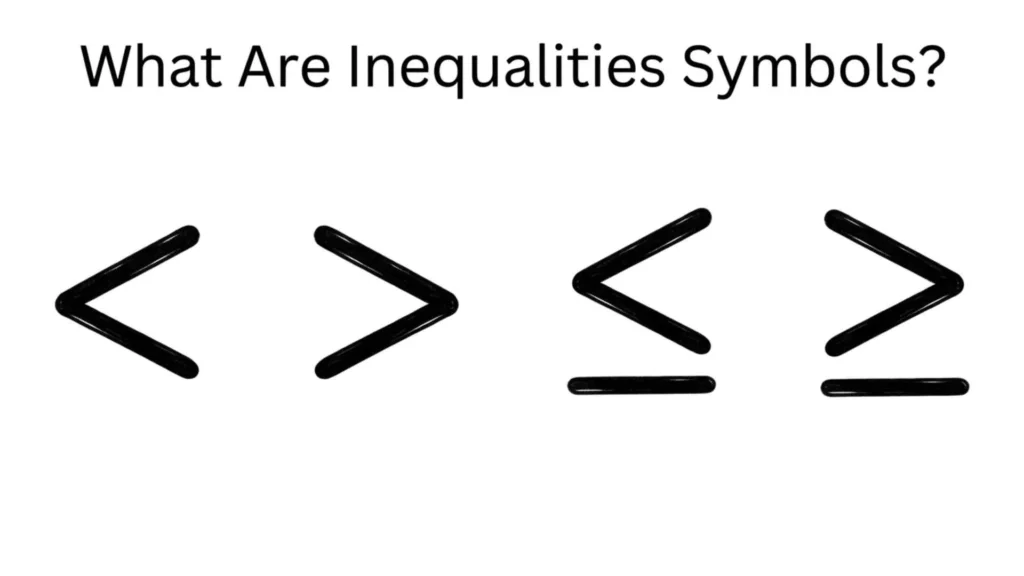
Inequalities symbols are mathematical signs used to compare two values or expressions. Instead of showing that two things are equal, they show that one value is greater than, less than, or not equal to another.
These symbols help people understand relationships between numbers, quantities, measurements, and conditions. They are widely used in mathematics, science, economics, computer programming, engineering, and statistics.
The most common inequalities symbols are:
| Symbol | Meaning |
| > | Greater than |
| < | Less than |
| ≥ | Greater than or equal to |
| ≤ | Less than or equal to |
| ≠ | Not equal to |
For example:
7>37>37>3
This means 7 is greater than 3.
Another example:
x≤10x\leq10x≤10
This means x can be 10 or any number smaller than 10.
These symbols may look simple, but they play a massive role in understanding logic and comparison.
The Fascinating History Behind Inequalities Symbols
The origin of inequalities symbols dates back centuries. Before symbols existed, mathematicians had to write comparisons using long sentences in Latin or Greek. This made mathematics slow and difficult to read.
The greater than and less than symbols were first introduced by English mathematician Thomas Harriot in the early 1600s. He used these signs in his book on algebra to simplify mathematical comparison. His idea transformed mathematics forever.
The shape of the symbols is meaningful. The open side faces the larger value, while the pointed side faces the smaller value. This visual structure makes comparison easier for the human brain to process quickly.
Did you know?
The equality symbol = was invented before inequalities symbols. Mathematicians later realized they also needed symbols to compare values that were not equal.
Over time, additional inequality signs like ≥ and ≤ were developed to express more complex conditions. Today, they are used in almost every branch of science and technology.
Understanding the Main Inequalities Symbols in Simple Language
Greater Than Symbol >
The greater than symbol shows that one value is larger than another.
Example:
15>915>915>9
This means 15 is greater than 9.
Emotional Meaning
Psychologically, the greater than symbol often represents growth, ambition, success, and achievement. People emotionally connect “greater” with winning or progress.
Real Life Example
If your bank account has more money this month than last month, your savings are greater than before.
Less Than Symbol <
The less than symbol shows that one value is smaller than another.
Example:
4<124<124<12
This means 4 is less than 12.
Emotional Meaning
This symbol can represent limitation, humility, simplicity, or even scarcity. In psychology, people often associate “less” with lower status or reduced opportunity.
Easy Trick to Remember
Many students remember it using the “hungry crocodile” trick. The open mouth always eats the bigger number.
Greater Than or Equal To ≥
This symbol means a value can either be greater than or exactly equal to another value.
Example:
x≥5x\geq5x≥5
This means x can be 5 or anything larger.
Practical Meaning
This symbol is often used in eligibility rules.
For example:
Age ≥ 18 means you must be at least 18 years old.
Emotional Representation
It symbolizes inclusion, acceptance, and possibility. It leaves room for equality instead of strict separation.
Less Than or Equal To ≤
This symbol means a value can be smaller than or exactly equal to another value.
Example:
y≤20y\leq20y≤20
This means y can be 20 or less.
Everyday Example
A speed limit sign saying speed ≤ 60 means drivers cannot go above 60.
Psychological Meaning
This often represents boundaries, safety, and protection. Rules and limits in life are commonly expressed using this idea.
Not Equal To ≠
The not equal to symbol means two values are different.
Example:
8≠108\neq108=10
This means 8 is not equal to 10.
Emotional Symbolism
This symbol strongly connects with individuality and uniqueness. It represents the idea that things do not always have to match.
Why Inequalities Symbols Matter in Everyday Life
Most people think inequalities symbols only belong in school math books. In reality, they influence modern life constantly.
In Finance and Money
Banks and businesses use inequalities to measure profit, debt, savings, and spending limits.
Example:
Expenses < Income means you are financially stable.
In Health and Fitness
Doctors use inequalities to track safe ranges for blood pressure, cholesterol, and weight.
Example:
Heart rate ≤ safe limit helps doctors protect patients.
In Technology and Coding
Computer programs rely heavily on inequality operators. Software developers use them to create conditions and decisions inside apps and websites.
Example:
If age ≥ 18, allow account access.
In Education
Teachers use inequalities to define grade boundaries.
Example:
Marks ≥ 90 may represent an A grade.
In Sports
Score comparisons determine winners and rankings.
Example:
Team A > Team B means Team A wins.
Did you know?
Artificial intelligence systems also use inequalities symbols in algorithms and machine learning models to make decisions.
How Different Cultures View the Meaning of Comparison Symbols
Although inequalities symbols are mathematical, the idea of comparison exists deeply in every culture. Different societies emotionally interpret “greater” and “less” in unique ways.
United States and Western Europe
In many Western cultures, greater than often symbolizes success, competition, achievement, and upward mobility. Society frequently encourages people to become “greater” through education and career growth.
Less than may sometimes carry emotional pressure because modern culture often links value with performance and wealth.
Asian Cultures
In many Asian societies, balance and harmony are more important than individual superiority. While inequalities are accepted in education and business, cultural traditions often emphasize respect, cooperation, and collective success.
The concept of “less than” may also symbolize humility, which is viewed positively in many Asian philosophies.
African Perspectives
Across many African traditions, community and shared progress matter deeply. Comparisons are often understood through relationships rather than competition alone.
Greater than may symbolize responsibility and leadership rather than personal dominance.
Symbolism in Spiritual Thinking
Many spiritual teachings suggest that comparison can create suffering. The emotional side of inequalities reminds people that human worth should not always be measured by “more” or “less.”
This deeper meaning gives inequalities symbols a surprisingly philosophical dimension.
Common Mistakes Students Make With Inequalities Symbols
Understanding inequalities symbols is easy once you avoid common errors.
Mixing Up > and <
This is the most frequent mistake.
Easy memory trick:
The open side always faces the larger number.
Example:
12>512>512>5
The open side points toward 12 because 12 is bigger.
Forgetting to Flip the Sign
When multiplying or dividing inequalities by negative numbers, the symbol direction changes.
Example:
−2x>8-2x>8−2x>8
Dividing by negative 2 gives:
x<−4x<-4x<−4
Many learners forget this important rule.
Confusing ≤ and <
Remember:
< means strictly smaller
≤ means smaller or equal
This tiny difference changes the meaning completely.
Easy Ways to Remember Inequalities Symbols Forever
The Hungry Crocodile Method
Imagine the symbol as a crocodile mouth. The crocodile always wants to eat the bigger number.
Example:
9>29>29>2
The mouth opens toward 9 because 9 is larger.
Use Real Life Comparisons
Connecting symbols with real situations improves memory.
Examples:
Salary > Expenses
Temperature < Freezing Point
Age ≥ 21
Practice With Visual Patterns
The larger opening naturally points to the bigger value. This visual learning method works especially well for children.
Learn Through Emotion
People remember concepts better when emotions are attached. Think of:
Greater than = growth
Less than = limitation
Equal to = balance
Inequalities Symbols in Advanced Mathematics
As students grow academically, inequalities become more powerful and complex.
Algebraic Inequalities
Algebra uses variables instead of fixed numbers.
Example:
2x+3>112x+3>112x+3>11
Solving gives:
x>4x>4x>4
Graphing Inequalities
Inequalities can also be represented visually on graphs.
Example:
y>xy>xy>x
This creates a shaded region showing all possible solutions.
Compound Inequalities
These combine multiple conditions.
Example:
3<x<103<x<103<x<10
This means x is greater than 3 and less than 10.
Inequalities in Calculus and Statistics
Scientists use inequalities to analyze probability, risk, optimization, and prediction models. Without inequalities, modern science and technology would struggle to function accurately.
Emotional and Psychological Meaning of Inequalities Symbols
Symbols shape human thinking more than many people realize. Inequalities are not just mathematical tools. They influence emotions, identity, and perception.
The Desire to Be Greater
Humans naturally seek improvement. The greater than symbol emotionally connects with ambition, confidence, and achievement. It reflects the human drive to grow stronger and better.
Fear of Being Less
The less than symbol can sometimes trigger feelings of insecurity or inadequacy. Society often teaches people to compare themselves constantly.
Equality and Human Connection
Symbols like ≥ and ≤ soften harsh comparison by including equality. They represent fairness, opportunity, and compassion.
Did you know?
Psychologists say excessive social comparison can affect happiness and mental health. This shows how deeply the idea of inequalities influences human emotions.
FAQs About Inequalities Symbols
What are inequalities symbols used for?
Inequalities symbols compare values and show whether one quantity is greater, smaller, or different from another. They are used in math, science, coding, economics, and daily life.
What is the difference between < and ≤?
The symbol < means strictly less than, while ≤ means less than or equal to.
Why do inequality signs flip with negative numbers?
When multiplying or dividing by a negative number, the direction changes because the order of values reverses on the number line.
What is the easiest way to remember inequalities symbols?
The hungry crocodile trick is one of the easiest memory methods. The crocodile always eats the larger number.
Are inequalities symbols important in programming?
Yes. Programmers use inequalities constantly in conditions, algorithms, and logical operations.
Who invented inequalities symbols?
English mathematician Thomas Harriot introduced greater than and less than symbols in the 1600s.
How are inequalities used in real life?
They are used in finance, health, education, sports, engineering, technology, and scientific research.
Conclusion
Inequalities symbols may appear small, but their meaning is enormous. They help people compare, analyze, measure, and understand the world around them. From classrooms and coding systems to emotions and philosophy, these symbols quietly shape how humans think about value and balance.
Once you understand the meaning of inequalities symbols, math becomes far less intimidating. You begin to see these signs not as confusing marks, but as powerful tools of communication. They represent growth, limitation, fairness, opportunity, and difference in ways that connect deeply with real life.
Whether you are a student, teacher, programmer, or curious learner, mastering inequalities opens the door to clearer thinking and stronger problem solving skills. The next time you see a greater than or less than sign, you will understand the story behind the symbol, not just the rule.

Amelia Scott is a passionate writer and symbolism researcher who explores the hidden meanings behind ancient signs, spiritual icons and cultural symbols. She enjoys uncovering the stories and mysteries connected to symbols from around the world.
She is the author of “Mystic Marks And Secret Meanings” and “Echoes Of Forgotten Symbols”. Her work combines history, spirituality and mythology to help readers better understand the deeper meaning of symbols in everyday life.
Through her writing, Amelia aims to make the world of symbols fascinating, meaningful and easy to explore.