
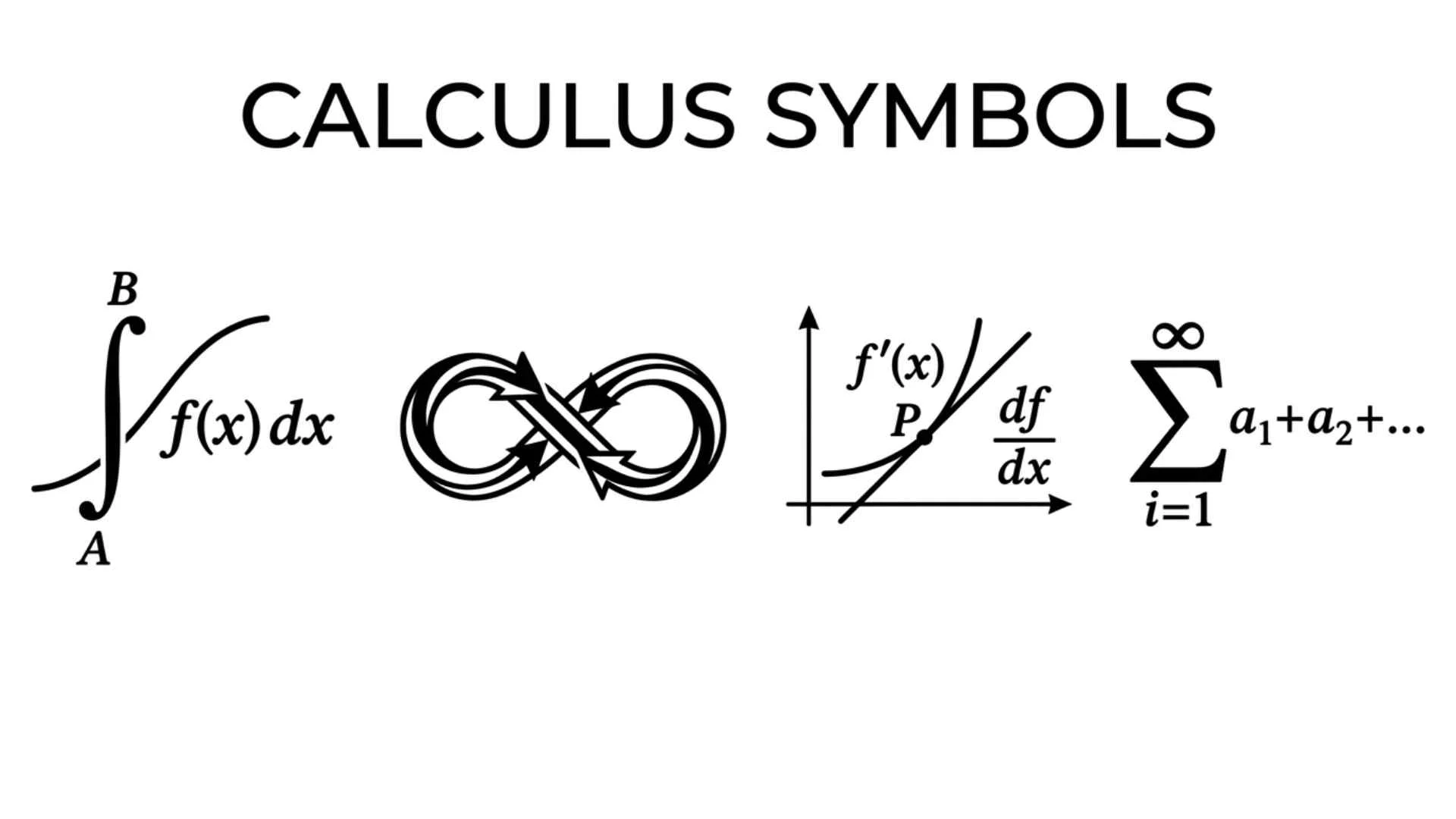
Have you ever looked at a math equation and felt like it was written in a secret code? Calculus symbols can feel exactly like that at first glance. Yet, once you understand them, they unlock a powerful way of seeing the world, from motion and change to growth and patterns in everyday life. In the first moments of learning calculus symbols, many people feel overwhelmed, but what if these symbols are not just mathematical tools, but meaningful signs that tell a deeper story about how life itself evolves?
Let’s decode this fascinating language together in a way that actually makes sense, feels human, and stays with you.
Calculus Symbols and Meanings
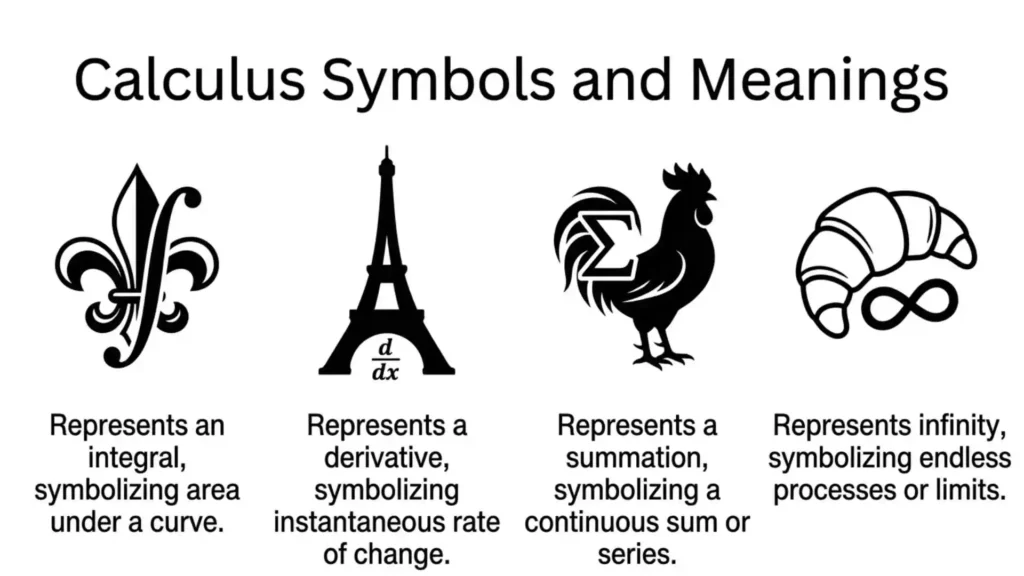
Calculus uses special symbols to represent mathematical operations, functions, and concepts. These symbols help students solve problems involving change, motion, growth, and area. Understanding calculus symbols is an important step in learning mathematics, physics, engineering, and data science.
Some of the most common calculus symbols include the integral sign (∫), derivative notation (d/dx), limit symbol (lim), partial derivative (∂), and infinity symbol (∞). Each symbol has a specific meaning and purpose in mathematical calculations.
Calculus Symbols with Examples
Learning calculus symbols with examples makes mathematical notation easier to understand. Here are some commonly used symbols:
| Symbol | Meaning | Example |
|---|---|---|
| ∫ | Integral | ∫ x² dx |
| d/dx | Derivative | d/dx(x²) = 2x |
| lim | Limit | lim x→0 (sin x)/x |
| ∂ | Partial Derivative | ∂f/∂x |
| Δ | Change | Δx = x₂ − x₁ |
| ∞ | Infinity | x → ∞ |
These examples show how calculus notation is used to represent mathematical relationships and solve real-world problems.
Calculus Symbols Copy and Paste
Many students and teachers need calculus symbols for assignments, notes, websites, and presentations. Below are common calculus symbols you can copy and paste:
Basic Calculus Symbols
∫ ∮ ∬ ∭ ∂ ∇ Δ ∞ π e
Comparison Symbols
≈ ≠ ≤ ≥
Common Calculus Notation
dy/dx
d²y/dx²
∂/∂x
lim
∑
→
These symbols are widely used in mathematics, engineering, economics, and scientific research.
Calculus Symbols e
The symbol e is known as Euler’s Number and is one of the most important mathematical constants in calculus.
e\approx2.71828
Euler’s Number appears in exponential growth, natural logarithms, compound interest, population models, and differential equations. Because many natural processes grow continuously, the constant e plays a major role in calculus and advanced mathematics.
Integral Calculus Symbols
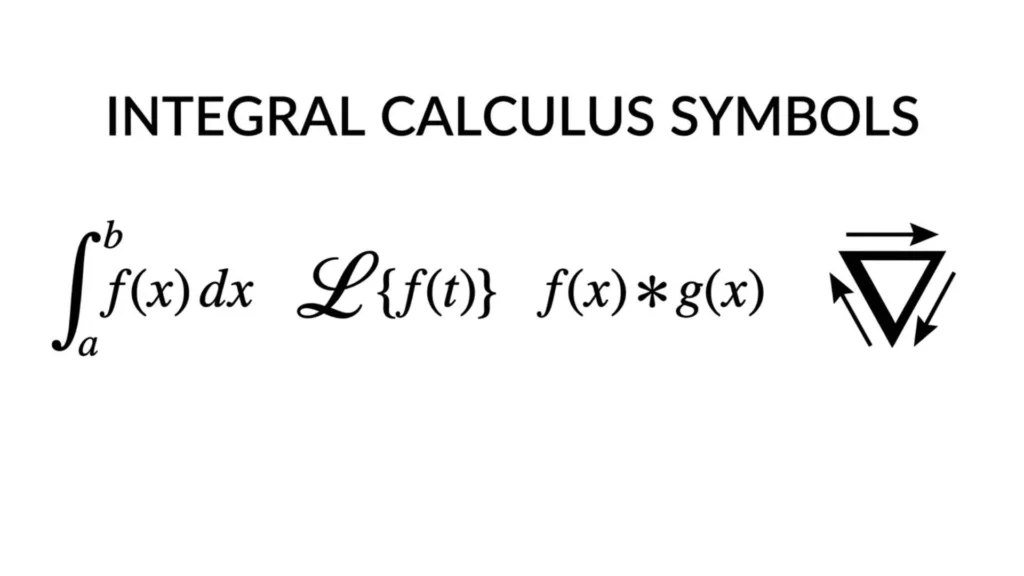
Integral calculus focuses on accumulation, total change, area under a curve, and volume calculations. Several symbols are commonly used in this branch of mathematics.
Important integral calculus symbols include:
- ∫ = Integral
- dx = Differential
- ∮ = Contour Integral
- ∬ = Double Integral
- ∭ = Triple Integral
- ∞ = Infinity
A common integral expression is:
\int_a^b f(x),dx
This notation is used to calculate the area under a function between two points.
Calculus Symbols and Names
Knowing the names of calculus symbols helps students understand equations and formulas more effectively.
| Symbol | Name |
|---|---|
| ∫ | Integral |
| ∂ | Partial Derivative |
| Δ | Delta |
| ∇ | Nabla |
| ∞ | Infinity |
| ∑ | Summation |
| π | Pi |
| e | Euler’s Number |
| lim | Limit |
| d | Differential |
These symbols are commonly found in calculus textbooks, scientific papers, and engineering calculations.
Differential Calculus Symbols
Differential calculus studies rates of change and the slope of curves. It uses special symbols to represent derivatives and mathematical change.
Common differential calculus symbols include:
- d/dx = Derivative Operator
- dy/dx = First Derivative
- d²y/dx² = Second Derivative
- ∂ = Partial Derivative
- Δx = Change in x
- Δy = Change in y
A simple derivative example is:
\frac{d}{dx}(x^2)=2x
Differential calculus is used in engineering, economics, physics, machine learning, and many other fields to analyze change and predict outcomes.
Calculus Symbols PDF
A calculus symbols PDF is a useful reference guide for students, educators, and professionals. It provides a complete list of calculus notation, symbols, formulas, and definitions in one easy-to-access document.
Many learners use calculus symbol charts and printable PDFs to review derivatives, integrals, limits, and mathematical constants. A well-organized PDF can improve learning, simplify revision, and make complex mathematical concepts easier to understand.
What Are Calculus Symbols and Why Do They Matter?
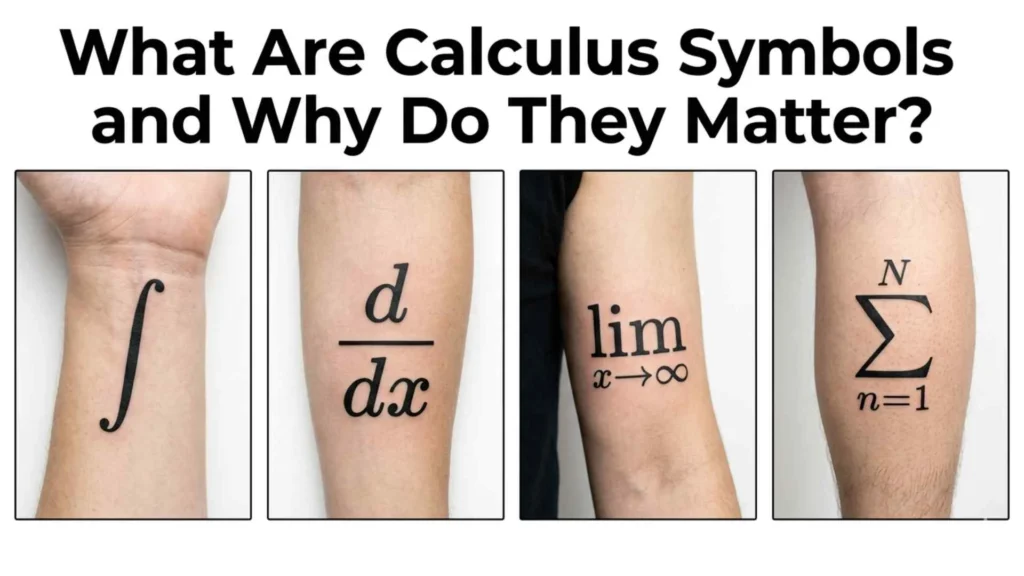
Calculus symbols are the building blocks of a mathematical language designed to describe change, motion, and relationships between quantities. Instead of long sentences, mathematicians use compact symbols to express powerful ideas.
Think of them as emotional shortcuts. Just like emojis express feelings instantly, calculus symbols capture complex ideas in a single character.
For example:
- The symbol ∫ tells a story of accumulation, growth, and totality
- The symbol d represents change, movement, and transformation
These symbols are not random. They were carefully created to make thinking clearer and faster.
Emotional Meaning
At a deeper level, calculus symbols reflect life itself:
- Change is constant
- Growth is gradual
- Small steps create big outcomes
Understanding them is like understanding the rhythm of the universe.
The Derivative Symbol d or d/dx: The Language of Change
One of the most important calculus symbols is the derivative, written as:
- d/dx
- f′(x)
This symbol measures how something changes over time or space.
Practical Meaning
If you are driving a car, your speed is a derivative. It tells how your position changes with time.
Emotional Connection
The derivative represents growth, progress, and transformation. It is about how small actions shape your journey.
Historical Insight
This symbol was introduced by Gottfried Wilhelm Leibniz, who believed math should reflect real-world processes. His notation made calculus easier to understand and is still widely used today.
Cultural Perspective
- In Western education, it represents precision and analytical thinking
- In Asian learning systems, it symbolizes discipline and step-by-step growth
- In African storytelling traditions, the idea of gradual change mirrors natural cycles and evolution
Did You Know?
The derivative is used in everything from predicting stock markets to designing roller coasters.
The Integral Symbol ∫: The Symbol of Accumulation and Wholeness
The integral symbol ∫ looks like an elongated “S,” and that is not accidental.
What It Means
It stands for “sum” or accumulation of infinitely small pieces.
Real-Life Example
Imagine filling a glass with water drop by drop. The integral measures the total water collected.
Emotional Meaning
This symbol represents:
- Patience
- Consistency
- The power of small efforts
It reminds us that big achievements come from tiny repeated actions.
Historical Origin
The symbol was also introduced by Leibniz. It comes from the Latin word “summa,” meaning total.
Cultural Interpretation
- In Europe, it reflects logical completeness
- In Asian philosophy, it aligns with the idea of harmony and balance
- In African traditions, it mirrors the idea that community efforts build something greater
Did You Know?
Integral calculus is used to calculate areas, volumes, and even probabilities in real life.
The Limit Symbol lim: The Edge of Possibility
The limit symbol is written as:
lim (x → a)
It describes what happens as a value approaches something.
Meaning in Simple Terms
It answers the question: What is something getting closer to, even if it never fully reaches it?
Emotional Meaning
The limit symbolizes:
- Aspiration
- Potential
- The journey toward a goal
It reflects how we often strive toward something greater, even if perfection is never fully reached.
Real-Life Example
When you save money, your bank balance grows closer to your goal amount. That is a limit in action.
Cultural Perspective
- In Western thought, it reflects boundaries and precision
- In Eastern philosophy, it connects to the idea of infinite potential
- In African perspectives, it aligns with cycles and gradual progression
The Infinity Symbol ∞: Beyond Boundaries
The infinity symbol is one of the most recognizable symbols in calculus.
What It Represents
It means something without end.
Emotional Meaning
Infinity stands for:
- Endless possibilities
- Eternal growth
- Limitless imagination
It resonates deeply with human curiosity and ambition.
Cultural Significance
- In Western culture, it often symbolizes eternity and love
- In Asian traditions, it represents continuous flow and balance
- In African symbolism, it connects with cycles of life and nature
Did You Know?
Infinity is not a number. It is an idea, a concept that helps us understand things that never stop.
The Delta Symbol Δ: The Sign of Change and Difference
The Greek letter delta (Δ) represents change.
Meaning
It shows the difference between two values.
For example:
Δx means change in x
Emotional Meaning
Delta represents:
- Transformation
- Turning points
- Growth moments
It reminds us that change is necessary for progress.
Real-Life Example
If your salary increases, that increase is your delta.
Cultural Insight
- In the USA, it reflects progress and innovation
- In Asia, it aligns with continuous improvement
- In Africa, it mirrors natural transformation, like seasons changing
Sigma Symbol Σ: The Power of Summation
Sigma (Σ) is used to represent the sum of many values.
Meaning
It adds up a sequence of numbers.
Emotional Interpretation
Sigma stands for:
- Unity
- Collective strength
- The power of many small parts working together
Real-Life Example
Your total monthly expenses are a sigma of all your daily spending.
Cultural Perspective
- In Western systems, it emphasizes structure and organization
- In Asian cultures, it reflects teamwork and harmony
- In African communities, it strongly connects with collective effort
The Pi Symbol π: The Bridge Between Geometry and Calculus
Pi (π) is a constant approximately equal to 3.14159.
Meaning
It represents the ratio of a circle’s circumference to its diameter.
Emotional Meaning
Pi symbolizes:
- Consistency
- Mystery
- Beauty in patterns
It shows how simple shapes hold deep truths.
Cultural Relevance
- In Europe, it represents mathematical elegance
- In Asia, it reflects balance and symmetry
- In Africa, circular patterns symbolize unity and continuity
Did You Know?
Pi never ends and never repeats, making it both predictable and mysterious.
Lesser Known Calculus Symbols You Should Know
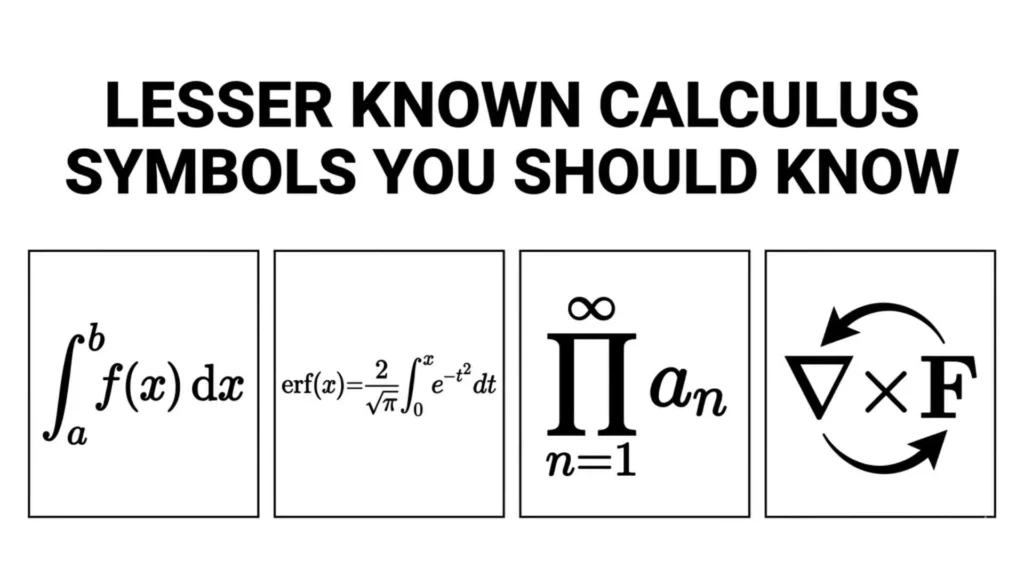
Beyond the basics, there are other symbols that add depth to calculus:
Partial Derivative ∂
Used when dealing with functions of multiple variables.
Emotional meaning: Complexity and interconnectedness
Nabla ∇
Used in vector calculus.
Emotional meaning: Direction and exploration
Approximately Equal ≈
Shows estimation.
Emotional meaning: Acceptance of imperfection
Why Learning Calculus Symbols Changes How You Think
Understanding calculus symbols is not just about math. It reshapes your mindset.
You Start Seeing Patterns Everywhere
From business growth to personal habits, everything becomes measurable and understandable.
You Develop Problem-Solving Skills
These symbols train your brain to break down complex problems into simple steps.
You Gain Confidence
What once looked like a confusing code becomes a powerful tool you can control.
FAQs About Calculus Symbols
1. What are the most important calculus symbols to learn first?
Start with derivative d/dx, integral ∫, limit lim, and delta Δ. These form the foundation.
2. Why are calculus symbols so confusing at first?
They are a new language. Like learning any language, it takes time and practice.
3. Who invented calculus symbols?
Isaac Newton and Gottfried Wilhelm Leibniz developed calculus, but Leibniz introduced most of the symbols we use today.
4. Are calculus symbols used in real life?
Yes, they are used in engineering, physics, economics, medicine, and technology.
5. What does the infinity symbol mean in calculus?
It represents something that has no end, often used in limits and integrals.
6. How can I memorize calculus symbols easily?
Understand their meaning and connect them to real-life examples instead of memorizing blindly.
7. Is calculus hard to learn?
It can feel challenging at first, but once you understand the symbols, it becomes much easier.
Conclusion: The Beauty Behind Calculus Symbols
Calculus symbols are not just marks on paper. They are a powerful language that describes how the world changes, grows, and evolves. From the smallest detail to the biggest concept, these symbols help us make sense of everything around us. Once you understand them, they stop being confusing and start becoming meaningful tools that shape your thinking. Learning calculus symbols is not just about math, it is about seeing life differently, with clarity, depth, and confidence.

Joseph Walker is a passionate writer and researcher focused on symbols, hidden meanings, ancient signs, and cultural symbolism from around the world. He enjoys exploring the stories and mysteries behind spiritual icons, mythological signs and historical emblems.
He is the author of “The Power Behind Timeless Symbols”. His work helps readers understand the deeper meanings of symbols in a simple and engaging way.
Through his articles, Joseph aims to make symbolism easier to explore for curious minds and modern readers.