
Have you ever noticed certain signs, patterns, or symbols appearing again and again in your life? These are often called destiny symbols, and many people believe they carry deeper meaning about who we are and where we are going. From ancient civilizations to modern psychology, destiny symbols have been used to guide decisions, reveal purpose, and connect us with something greater than ourselves. Whether you see them in dreams, nature, or cultural traditions, these symbols can feel like whispers from the universe pointing you toward your true path.
In this guide, we will explore the powerful world of destiny symbols, their meanings, origins, and how they can influence your life in both emotional and practical ways.
What Are Destiny Symbols and Why Do They Matter?
Destiny symbols are visual signs, patterns, or icons believed to represent fate, purpose, and life direction. These symbols often appear in spiritual traditions, mythology, dreams, and even everyday experiences.
People connect with destiny symbols because they offer a sense of meaning in uncertain times. They can act as reminders, warnings, or encouragement depending on how they appear in your life.
Psychologically, humans are wired to look for patterns. When we attach meaning to symbols, it helps us make sense of our experiences. This is why destiny symbols often feel deeply personal, even when they are widely recognized across cultures.
Did you know? The human brain processes images 60,000 times faster than text, which explains why symbols feel so powerful and immediate.
The Ancient Origins of Destiny Symbols
Destiny symbols are not a modern idea. They have been part of human culture for thousands of years.
In ancient Egypt, symbols like the Ankh represented eternal life and divine destiny. In Greek mythology, the Moirai or Fates used symbolic threads to represent each person’s life path. In Asian traditions, symbols such as the Yin Yang reflect balance and the natural flow of destiny.
Across Africa, tribal symbols often carry meanings tied to ancestry, purpose, and spiritual guidance. In Native American cultures, animals and natural elements are seen as symbols guiding one’s life journey.
These traditions show that across time and geography, humans have always searched for signs that explain their destiny.
Most Powerful Destiny Symbols and Their Meanings
The Infinity Symbol
The infinity symbol represents endless possibilities and eternal cycles. It suggests that your destiny is not fixed but constantly evolving.
Emotionally, it reminds you that growth never stops. No matter where you are, there is always another chapter waiting.
The Labyrinth
The labyrinth symbolizes a journey toward self-discovery. Unlike a maze, it has only one path, representing the idea that your destiny is already unfolding step by step.
Psychologically, it reflects inner exploration and personal transformation.
The Phoenix
The phoenix stands for rebirth and renewal. It represents rising from failure or hardship stronger than before.
Across cultures, it symbolizes hope, resilience, and transformation. In Western traditions, it reflects personal rebirth, while in Eastern cultures, it also represents harmony and virtue.
The Tree of Life
This symbol connects heaven, earth, and the underworld. It represents growth, connection, and life’s continuous cycle.
Emotionally, it reminds you that your destiny is rooted in your past but growing toward your future.
The Compass
The compass is a direct symbol of direction and guidance. It suggests that even when you feel lost, you have an inner guide pointing you toward your true path.
In modern life, it often represents decision-making and finding purpose.
Destiny Symbols in Different Cultures
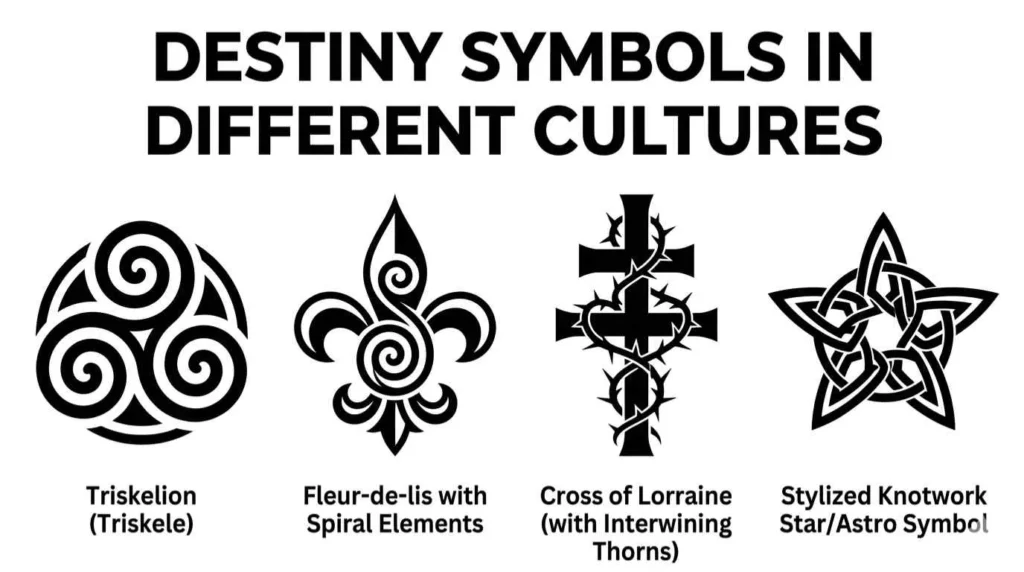
Western Perspective
In Western cultures, destiny symbols often focus on individual purpose and personal success. Symbols like stars, arrows, and keys represent ambition, direction, and unlocking potential.
Asian Traditions
Asian cultures emphasize balance and harmony. Symbols like the Yin Yang show that destiny is about maintaining equilibrium rather than chasing a single goal.
African Symbolism
African symbols often focus on community and ancestry. Destiny is seen as something connected to family roots and collective identity rather than just individual achievement.
Indigenous and Native Beliefs
Nature plays a central role. Animals, weather patterns, and natural elements act as destiny symbols guiding life choices and spiritual growth.
This cultural diversity shows that while the symbols may differ, the idea of destiny is universal.
Psychological Meaning of Destiny Symbols
From a psychological perspective, destiny symbols are closely linked to the subconscious mind.
When you repeatedly notice a symbol, it may reflect your inner thoughts, fears, or desires. For example, seeing a path or road symbol could indicate that you are thinking about life choices or transitions.
Carl Jung introduced the idea of archetypes, which are universal symbols shared across humanity. Destiny symbols often fall into this category, which is why people from different cultures can relate to them.
Emotionally, these symbols can:
- Provide comfort during uncertainty
- Help you process life changes
- Encourage self-reflection
- Strengthen intuition
In simple terms, destiny symbols act like mirrors, showing you what is happening inside your mind and heart.
How to Recognize Destiny Symbols in Your Life
Destiny symbols do not always appear in obvious ways. Sometimes they show up in subtle, everyday moments.
You might notice:
- Repeating numbers or patterns
- Dreams with recurring symbols
- Specific animals appearing frequently
- Certain shapes or signs catching your attention
The key is awareness. When something feels meaningful or keeps appearing, take a moment to reflect on it.
Ask yourself:
- What am I feeling right now?
- What is happening in my life?
- How could this symbol relate to my situation?
There is no universal interpretation that fits everyone. The meaning often depends on your personal experiences and emotions.
Using Destiny Symbols for Personal Growth
Destiny symbols are not just about observation. They can also be powerful tools for growth and self-improvement.
Journaling
Write down symbols you notice and what they might mean. Over time, patterns will start to appear.
Meditation
Focus on a symbol during meditation to explore its deeper meaning and how it connects to your life.
Decision Making
When faced with choices, think about symbols that represent your situation. This can help clarify your thoughts.
Creative Expression
Draw or create your own destiny symbols. This allows you to connect with your inner self in a meaningful way.
Using symbols actively can turn them into guides rather than just signs.
Common Misunderstandings About Destiny Symbols
Many people believe destiny symbols predict the future exactly. This is not entirely true.
Symbols are not fixed answers. They are guides that help you understand possibilities, not guarantees.
Another misconception is that symbols have the same meaning for everyone. While some interpretations are shared, personal context always matters.
It is also important to avoid overthinking. Not every small detail is a destiny symbol. Balance intuition with logic.
The Role of Intuition in Interpreting Symbols
Intuition plays a huge role in understanding destiny symbols. It is that quiet inner voice that helps you make sense of things beyond logic.
When you see a symbol, your first reaction is often the most accurate. Trusting that feeling can lead to deeper insights.
However, intuition works best when combined with awareness and reflection. It is not about guessing but about connecting with your inner understanding.
Modern-Day Destiny Symbols in Everyday Life
In today’s world, destiny symbols are not limited to ancient traditions. They appear in modern forms as well.
For example:
- Digital symbols like notifications or repeated messages
- Personal logos or tattoos that represent identity
- Road signs or directions that feel meaningful
Even social media trends can act as symbols, reflecting collective emotions and societal direction.
This shows that destiny symbols evolve with time but continue to serve the same purpose, guiding and connecting people.
Did You Know?
Many successful people use symbolic thinking in decision-making. They may not call them destiny symbols, but they rely on patterns, signs, and intuition to guide choices.
Also, studies in psychology show that people who find meaning in symbols often feel more fulfilled and motivated in life.
FAQs About Destiny Symbols
What are destiny symbols exactly?
Destiny symbols are signs or images that represent life direction, purpose, and personal meaning.
Can destiny symbols predict the future?
They do not predict exact outcomes but help guide your thoughts and decisions.
Are destiny symbols the same in every culture?
No, they vary across cultures, but many share similar themes like growth, balance, and transformation.
How do I know if a symbol is meant for me?
If it appears repeatedly and feels meaningful, it may be worth exploring.
Can I create my own destiny symbol?
Yes, personal symbols can be powerful because they reflect your unique experiences and emotions.
Are destiny symbols spiritual or psychological?
They can be both. Some people see them as spiritual signs, while others view them as reflections of the subconscious mind.
Why do I keep seeing the same symbol?
It could be your mind drawing attention to something important in your life.
Conclusion
Destiny symbols are more than just images or signs. They are powerful tools that connect your inner world with the outer world. Whether rooted in ancient traditions or modern experiences, these symbols offer guidance, clarity, and emotional strength. By paying attention to them, you can better understand your journey, make thoughtful decisions, and feel more connected to your purpose. The key is not to rely on them blindly but to use them as companions on your path, helping you grow, reflect, and move forward with confidence.

Joseph Walker is a passionate writer and researcher focused on symbols, hidden meanings, ancient signs, and cultural symbolism from around the world. He enjoys exploring the stories and mysteries behind spiritual icons, mythological signs and historical emblems.
He is the author of “The Power Behind Timeless Symbols”. His work helps readers understand the deeper meanings of symbols in a simple and engaging way.
Through his articles, Joseph aims to make symbolism easier to explore for curious minds and modern readers.