
Inequality symbols are everywhere in mathematics, science, coding, and even in real life decision making. From school classrooms to financial reports, these small signs quietly control how we compare values and understand differences. Yet most people only memorize them without truly understanding their deeper meaning.
Inequality symbols are more than just mathematical tools. They represent comparison, balance, hierarchy, and even human judgment in symbolic form. When we see them, we are actually interpreting relationships between numbers, ideas, and outcomes.
These symbols shape how we think about “more than” or “less than” in structured ways. They help us organize the world logically and make decisions based on comparison. Without them, modern mathematics and data analysis would not function smoothly.
In this guide, we will explore inequality symbols in a deeply simple and human way. You will learn their meaning, history, emotional interpretation, real life usage, and cultural understanding across the world.
By the end, you will see inequality symbols not just as math signs, but as powerful communication tools that reflect how humans understand difference and value.
What Are Inequality Symbols and Why They Matter in Mathematics
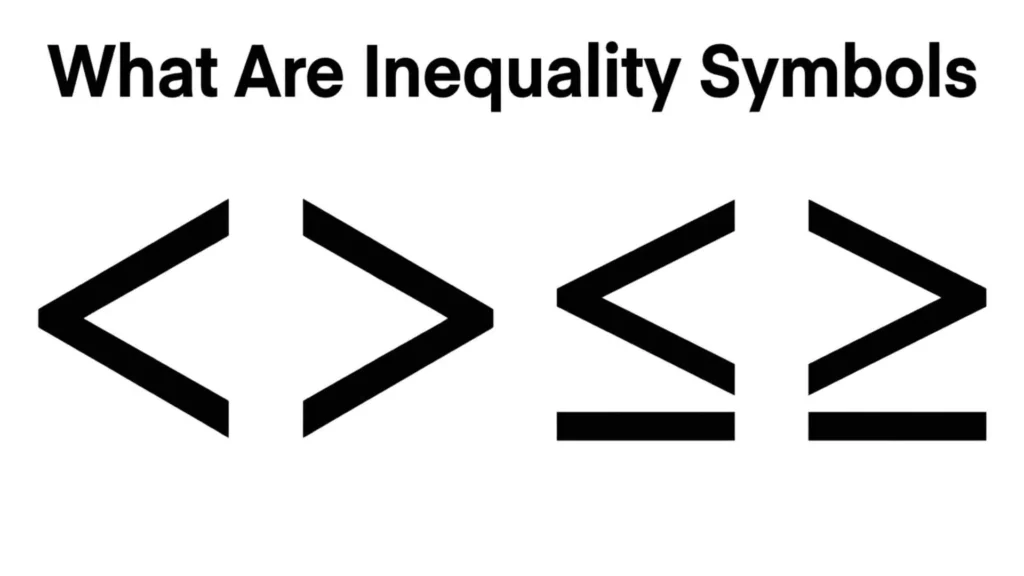
Inequality symbols are special mathematical signs used to compare two values. They show whether one quantity is greater than, less than, equal to, or not equal to another.
The most common inequality symbols include:
Less than symbol <
Greater than symbol >
Less than or equal to symbol ≤
Greater than or equal to symbol ≥
Not equal to symbol ≠
These symbols are fundamental in algebra, calculus, statistics, and everyday problem solving. They help define ranges, limits, and conditions instead of fixed values.
For example, instead of saying x equals 5, we can say x is greater than 5. This opens infinite possibilities, which is essential in real world mathematics.
Without inequality symbols, we would lose the ability to describe uncertainty, flexibility, and variation in data.
History and Origin of Inequality Symbols
The concept of inequality symbols developed gradually over centuries of mathematical evolution. Early mathematicians used words instead of symbols to express comparisons.
The modern symbols < and > were introduced in the 17th century by English mathematician Thomas Harriot. He created these symbols to simplify mathematical writing and improve clarity.
Later, other symbols like ≤ and ≥ were introduced as mathematics became more advanced in algebra and calculus.
Over time, these symbols became universal in education systems around the world. Today, they are part of basic mathematical language used globally.
Did you know that before symbols existed, mathematicians had to write full sentences like “is greater than” every time they compared numbers?
This made calculations slow and complex, which is why inequality symbols became such an important innovation in mathematics history.
Understanding Each Inequality Symbol in Simple Language
Let us break down each symbol in a very simple and practical way.
Less than symbol <
This means the value on the left is smaller than the value on the right.
Example: 3 < 5 means 3 is smaller than 5.
Greater than symbol >
This means the value on the left is bigger than the value on the right.
Example: 10 > 4 means 10 is larger than 4.
Less than or equal to symbol ≤
This means the value is either smaller or exactly equal.
Example: x ≤ 7 means x can be 7 or any number smaller than 7.
Greater than or equal to symbol ≥
This means the value is either larger or exactly equal.
Example: x ≥ 2 means x can be 2 or any number larger than 2.
Not equal to symbol ≠
This means two values are different and not the same.
Example: 8 ≠ 10 means 8 is not equal to 10.
These symbols help express conditions instead of fixed answers, making mathematics flexible and powerful.
How to Read Inequality Symbols in Real Life Situations
Inequality symbols are not limited to textbooks. They are used in everyday life more than we realize.
For example:
Temperature comparison
If today’s temperature is > 30 degrees, it means it is hot.
Budget planning
If spending ≤ income, it means you are financially safe.
Fitness tracking
If steps ≥ 10,000, it means you achieved your daily goal.
These symbols help us make decisions based on conditions rather than exact numbers.
In real life, inequality symbols act like silent decision makers guiding us in finance, health, weather, and planning.
Psychological and Emotional Meaning of Inequality Symbols
Beyond mathematics, inequality symbols also carry psychological meaning.
The greater than symbol often represents superiority, achievement, or growth. It can create a feeling of progress or advantage.
The less than symbol can represent limitation or being behind, but also simplicity and humility.
The not equal symbol represents uniqueness and individuality. It reminds us that nothing in life is exactly the same.
Emotionally, humans naturally compare themselves with others. Inequality symbols mirror this mental process in a structured form.
For example, people often think in terms of “better than” or “less than” when evaluating success, relationships, or achievements.
Did you know that psychologists believe comparison thinking is one of the strongest human cognitive behaviors, and inequality symbols are a mathematical reflection of it?
Inequality Symbols in Education and Learning Mathematics
In education, inequality symbols are one of the first advanced mathematical concepts students learn after basic arithmetic.
Teachers use number lines, visual charts, and real life examples to help students understand them.
Students often struggle at first because these symbols require logical thinking instead of memorization.
However, once understood, they become powerful tools for solving algebraic equations and word problems.
For example, solving inequalities helps students understand ranges like:
x > 5 means all numbers greater than 5
This introduces the concept of infinite solutions, which is a major step in mathematical thinking.
Educational systems around the world emphasize inequality symbols because they build logical reasoning skills.
Real Life Applications of Inequality Symbols in Science, Technology, and Economics
Inequality symbols are essential in many professional fields.
Science
In physics, inequality symbols define limits like temperature ranges, pressure conditions, and chemical reactions.
Economics
Economists use inequality symbols to analyze income distribution, inflation rates, and market trends.
Computer Programming
In coding, inequality symbols are used in conditions like if statements to control logic flow.
Engineering
Engineers use them to ensure safety limits are not exceeded in structures and machines.
Data Analysis
Data scientists use inequality symbols to filter datasets and find patterns.
Without these symbols, modern technology and analysis systems would not function properly.
They act as decision rules that guide machines and systems.
Cultural Interpretations of Inequality Symbols Around the World
Different cultures interpret comparison and inequality differently.
United States and Europe
In Western education, inequality symbols are seen as logical tools for analysis and competition. They are often associated with performance and achievement.
Asia
In many Asian cultures, comparison symbols are closely linked with discipline, ranking, and academic success. They are strongly used in education systems.
Africa
In African educational systems, inequality symbols are increasingly used in modern mathematics, often connected with practical life applications like trade and agriculture.
Middle East
In Middle Eastern education, inequality symbols are studied as part of formal logic and mathematical development, often linked with engineering and science fields.
Across all cultures, the meaning remains consistent: comparison, difference, and evaluation of value.
However, emotional interpretation may vary depending on cultural attitudes toward competition and hierarchy.
Common Mistakes and Misunderstandings About Inequality Symbols
Many students and learners make common mistakes when using inequality symbols.
One common mistake is reversing the symbol direction.
Another mistake is confusing ≤ and ≥ signs.
Some learners also forget that inequality symbols represent ranges, not single answers.
For example, x > 3 does not mean only 4 or 5, it means all numbers greater than 3.
Another misconception is thinking inequality symbols always represent positive values, which is not true.
They can include negative numbers as well.
Understanding these mistakes helps build stronger mathematical foundations.
Did You Know? Interesting Facts About Inequality Symbols
Inequality symbols are used not only in mathematics but also in artificial intelligence decision making systems.
They are part of algorithms that recommend movies, products, and even social media content.
Another interesting fact is that inequality thinking exists in nature too. For example, animals compete for resources based on “greater than” survival advantage conditions.
This shows that comparison is a natural principle, not just a human invention.
FAQs About Inequality Symbols
1. What are inequality symbols used for?
They are used to compare values and show relationships like greater than, less than, or not equal.
2. What is the difference between < and > symbols?
The < symbol means smaller than, while > means greater than.
3. Why are inequality symbols important in math?
They help express ranges, conditions, and multiple possible answers instead of fixed values.
4. Where are inequality symbols used in real life?
They are used in finance, science, coding, weather analysis, and daily decision making.
5. What does ≤ mean in mathematics?
It means a value is either less than or equal to another value.
6. Are inequality symbols used in programming?
Yes, they are used in logic conditions and decision making in code.
7. What is the emotional meaning of inequality symbols?
They often represent comparison, achievement, uniqueness, and difference in human thinking.
Conclusion
Inequality symbols are simple yet powerful tools that shape how we understand comparison in mathematics and life. They help express relationships beyond fixed numbers and allow flexibility in problem solving. From classrooms to computer systems, they are essential in logic and decision making.
These symbols also reflect human psychology, where comparison plays a major role in understanding success and value. Across cultures and disciplines, they remain universal in meaning and application.
Learning inequality symbols is not just about math. It is about understanding how the world measures difference, balance, and possibility.

Amelia Scott is a passionate writer and symbolism researcher who explores the hidden meanings behind ancient signs, spiritual icons and cultural symbols. She enjoys uncovering the stories and mysteries connected to symbols from around the world.
She is the author of “Mystic Marks And Secret Meanings” and “Echoes Of Forgotten Symbols”. Her work combines history, spirituality and mythology to help readers better understand the deeper meaning of symbols in everyday life.
Through her writing, Amelia aims to make the world of symbols fascinating, meaningful and easy to explore.