
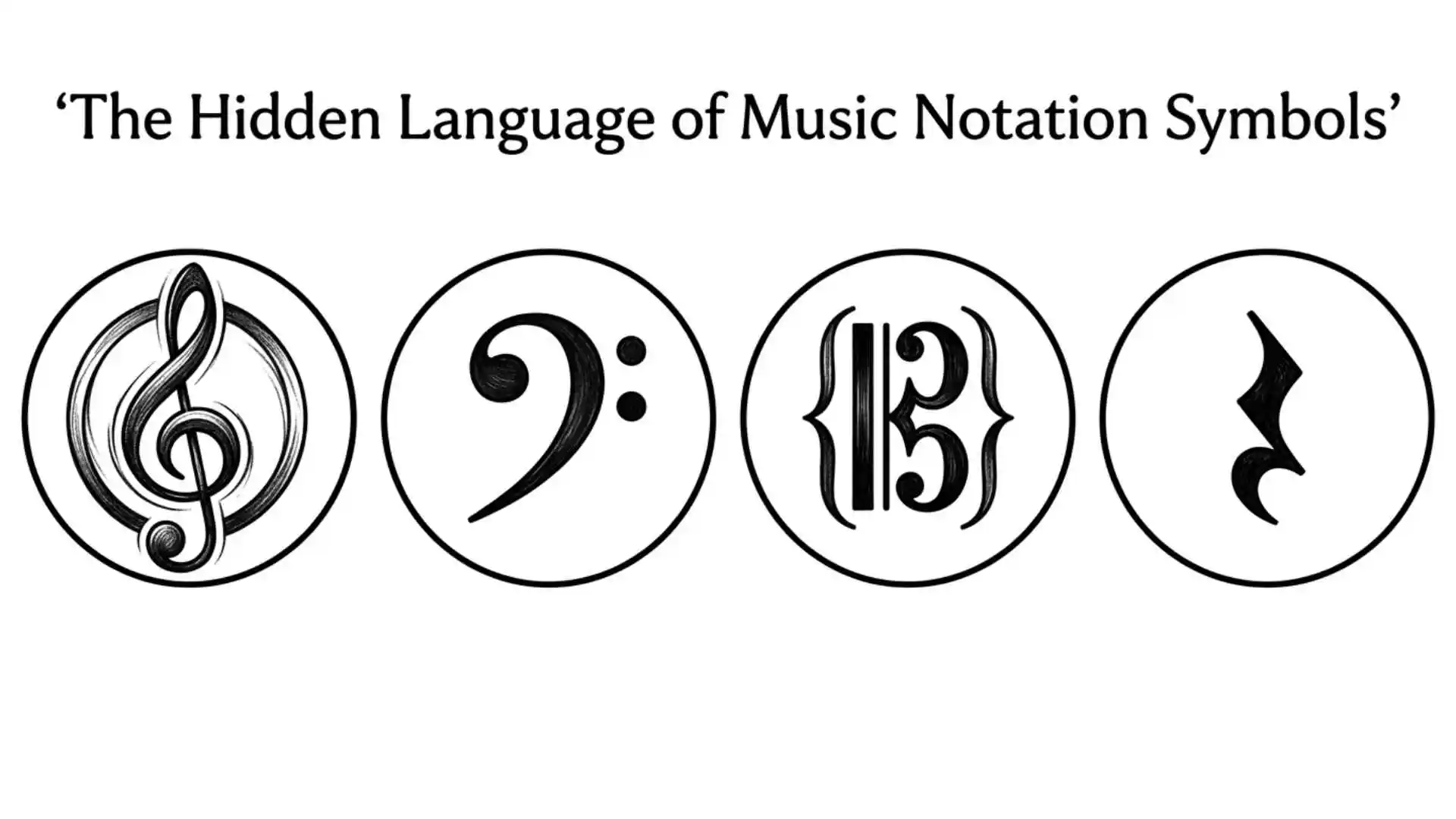
Music has a way of touching something deep inside us. A melody can bring back memories, a rhythm can move your body, and a single note can express what words cannot. But behind every powerful piece of music lies a silent language many people overlook, music notation symbols.
If you have ever looked at a sheet of music and felt confused, you are not alone. Those dots, lines, curves, and markings are not random. They are emotional instructions, telling musicians how to breathe life into sound. Understanding music notation symbols is like learning to read the soul of music itself.
In this guide, you will not only learn what these symbols mean, but also how they connect to human emotion, culture, and history. By the end, you will see sheet music not as a puzzle, but as a story waiting to be felt.
What Are Music Notation Symbols and Why Do They Matter?
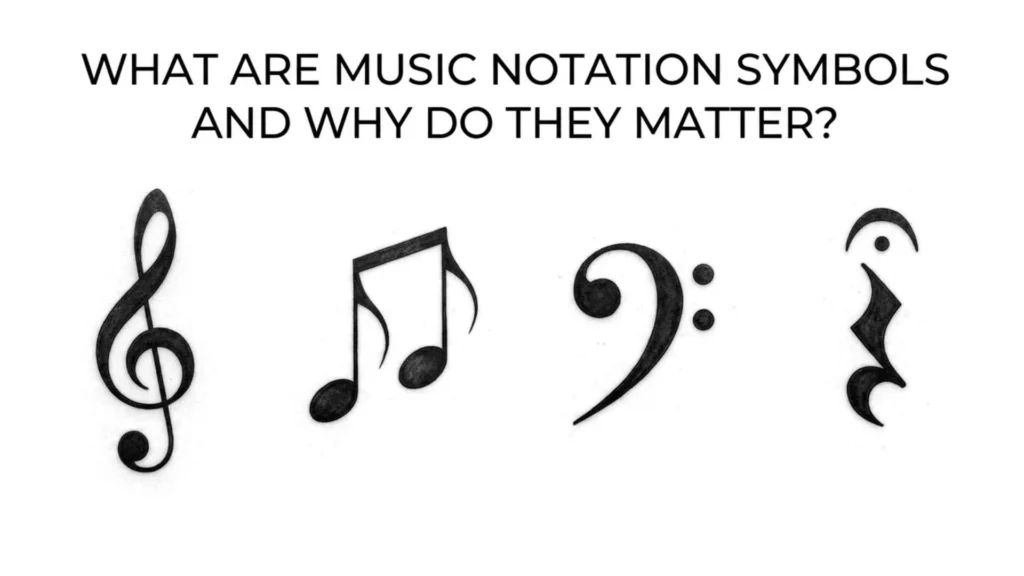
Music notation symbols are visual signs used to represent sound. They tell musicians what to play, how long to play it, how loud or soft it should be, and even how it should feel.
Think of them as the grammar of music. Without them, music would be chaotic and impossible to share accurately across time and cultures.
But here is the deeper truth. These symbols do more than guide performance. They carry emotion. A simple marking can transform a happy melody into something melancholic or turn a calm passage into a dramatic moment.
Did you know?
Before standardized notation, music was passed down orally. This meant emotions and styles changed over generations. Notation symbols helped preserve the original feeling of compositions.
The Staff, Clefs, and Notes: The Foundation of Musical Expression
At the heart of music notation is the staff, five horizontal lines where notes live. Each line and space represents a different pitch.
Clefs: The Starting Point of Understanding
Clefs tell you which notes belong to which lines. The most common are:
- Treble clef, often used for higher sounds like vocals and violins
- Bass clef, used for lower sounds like bass guitar and cello
Emotionally, clefs divide the musical world into light and deep tones. Treble often feels bright and expressive, while bass feels grounded and powerful.
Notes: The Voice of Music
Notes are the core symbols that represent sound. Their shape tells you how long to play them.
- Whole note feels calm and sustained
- Half note feels balanced
- Quarter note feels steady and rhythmic
Psychologically, longer notes create a sense of peace, while shorter notes bring energy and movement.
Across cultures, slow sustained notes are often used in spiritual music, while fast notes are common in celebrations and dances.
Rhythm Symbols: The Pulse That Connects Us
Rhythm is what makes music alive. It is the heartbeat that connects us instinctively.
Common Rhythm Symbols
- Time signatures, like 4 by 4, tell you how beats are grouped
- Rests show silence, which is just as important as sound
- Ties and dots extend note duration
Silence in music is powerful. A rest can create tension, anticipation, or emotional pause.
Did you know?
In African and Asian music traditions, rhythm often carries more importance than melody. Complex rhythmic patterns reflect community, storytelling, and movement.
Dynamics and Expression Symbols: Where Emotion Lives
If notes are words, dynamics are emotions. They tell you how loudly or softly to play.
Common Dynamic Symbols
- Piano means soft
- Forte means loud
- Crescendo means gradually getting louder
- Decrescendo means gradually getting softer
These symbols guide emotional storytelling. A crescendo can feel like rising excitement or tension. A soft passage can feel intimate, like a whisper.
In Western classical music, dynamics are detailed and precise. In contrast, many Eastern traditions rely more on interpretation and feeling, showing how emotion in music varies across cultures.
Articulation Symbols: The Personality of Each Note
Articulation symbols define how a note should be played, not just what note it is.
Key Articulation Symbols
- Staccato means short and detached
- Legato means smooth and connected
- Accent means emphasized
These small markings change everything. A staccato passage feels playful or sharp, while legato feels flowing and emotional.
Psychologically, articulation affects how we perceive intention. Short notes feel energetic or nervous, while smooth notes feel calm and expressive.
Musical Symbols Across Cultures: A Global Perspective
Music notation is not the same everywhere. While Western notation is widely used, other cultures have their own systems.
Western Music Notation
Highly structured and detailed, focusing on precision and harmony.
Indian Classical Notation
Uses a system called Sargam, focusing on relative pitch and improvisation. Emotion, or rasa, is central here.
Chinese and Japanese Systems
Often use symbolic or numeric notation, emphasizing melody and expression.
African Traditions
Many rely on oral transmission and rhythmic patterns rather than written symbols.
This diversity shows that music notation symbols are not just technical tools. They reflect how different cultures experience and express emotion.
The Psychology Behind Music Notation Symbols
Why do these symbols affect us so deeply?
Because they shape how music is performed, and performance shapes how we feel.
Emotional Triggers
- Loud dynamics can trigger excitement or stress
- Slow tempo can create calm or sadness
- Sharp articulation can feel tense or urgent
Music notation acts as a bridge between composer intention and listener emotion.
Did you know?
Studies show that certain musical patterns can influence heart rate and mood. The symbols guiding those patterns play a key role in this effect.
How Beginners Can Easily Learn Music Notation Symbols
Learning music notation may seem overwhelming, but it becomes simple with the right approach.
Start with the Basics
Focus on clefs, notes, and rhythm first. These are your foundation.
Practice Daily
Even 10 minutes a day can build familiarity and confidence.
Use Real Music
Practice with songs you love. This creates emotional connection and makes learning enjoyable.
Visual Memory Trick
Associate symbols with feelings. For example, think of crescendo as a wave rising. This makes them easier to remember.
Common Mistakes to Avoid When Learning Notation Symbols
Many beginners struggle because they approach music notation incorrectly.
Trying to Memorize Everything at Once
Music is a language. Learn it gradually, like learning to speak.
Ignoring Emotion
Do not treat symbols as just technical instructions. Feel them.
Skipping Practice
Understanding comes from doing, not just reading.
Did You Know? Fascinating Facts About Music Notation Symbols
- The modern system of music notation developed over 1,000 years
- Early notation used simple dots called neumes
- Beethoven continued composing even after losing his hearing, relying heavily on notation symbols
- Some modern composers create entirely new symbols for unique sounds
These facts show how notation continues to evolve with human creativity.
FAQs About Music Notation Symbols
What are music notation symbols used for?
They are used to represent pitch, rhythm, dynamics, and expression in written music so musicians can perform accurately.
Why are music notation symbols important?
They preserve musical ideas and ensure consistency across performances and generations.
Are music notation symbols the same worldwide?
No, different cultures have unique systems, though Western notation is the most widely used globally.
How long does it take to learn music notation?
Basic understanding can take a few weeks, but mastery develops over time with practice.
Can you play music without knowing notation symbols?
Yes, but knowing them gives you more freedom and understanding, especially when learning new pieces.
What is the hardest part of learning notation?
Most beginners struggle with rhythm and reading multiple notes at once.
Do music notation symbols affect emotion?
Yes, they guide how music is performed, which directly influences how it is felt.
Conclusion: Unlocking the Emotional Code of Music
Music notation symbols are more than marks on paper. They are a powerful language that connects sound, emotion, and human experience. Once you understand them, music becomes deeper, richer, and more personal.
You begin to see not just notes, but intention. Not just rhythm, but heartbeat. Not just symbols, but stories waiting to be told.
Whether you are a beginner or someone rediscovering music, learning these symbols opens a new world. A world where every line, curve, and dot has meaning. And once you step into it, you will never hear music the same way again.

Amelia Scott is a passionate writer and symbolism researcher who explores the hidden meanings behind ancient signs, spiritual icons and cultural symbols. She enjoys uncovering the stories and mysteries connected to symbols from around the world.
She is the author of “Mystic Marks And Secret Meanings” and “Echoes Of Forgotten Symbols”. Her work combines history, spirituality and mythology to help readers better understand the deeper meaning of symbols in everyday life.
Through her writing, Amelia aims to make the world of symbols fascinating, meaningful and easy to explore.